For centralized crypto exchanges, Proof of Reserves provides an additional layer of transparency because customers generally do not control the private keys associated with assets held in exchange custody.
Many exchanges use cryptographic techniques, such as Merkle trees, to allow users to verify that their account balances were included in a published reserve assessment.
However, Proof of Reserves is not a complete financial audit. It does not necessarily disclose all liabilities, establish solvency, or guarantee that customer funds will always be available for withdrawal.
Key Takeaways
-
Proof of Reserves helps verify an exchange's asset holdings. It provides evidence of cryptocurrency reserves and, when liabilities are included, whether those reserves cover the customer balances assessed.
-
Merkle trees enable individual verification. Users can cryptographically confirm that their account balances were included in a published liability snapshot without exposing other customers’ information.
-
Reserve ratios indicate reported coverage. A ratio above 100% means the reported reserve assets exceed the corresponding customer liabilities included in the calculation.
-
Users can independently check Gate’s Proof of Reserves. Gate provides reserve disclosures and account-level verification tools through its official Proof of Reserves page.
How Does Proof of Reserves Work?
Proof of Reserves compares an exchange’s reported reserve assets against the customer balances or liabilities included in a particular assessment.
A typical PoR process involves three components: identifying reserve assets, determining customer liabilities, and providing evidence that allows the reported information to be verified.
1. Identifying Exchange Reserve Assets
The exchange identifies cryptocurrency wallets and other assets included in its reserve assessment.
For on-chain assets, wallet balances can be checked against publicly available blockchain records.
The exchange may also provide cryptographic signatures or other evidence demonstrating control over the relevant wallet addresses.
However, identifying assets in a wallet does not automatically establish that they are unencumbered or exclusively available to satisfy customer claims.
2. Calculating Customer Liabilities
The exchange calculates the customer balances included in the assessment at a specified snapshot time.
These balances represent amounts the exchange owes customers within the scope of the assessment.
For example, if customers collectively hold 10,000 BTC on an exchange, the exchange would need at least 10,000 BTC in eligible reserves to demonstrate 100% BTC coverage under a like-for-like calculation.
The accuracy and completeness of the liability calculation are essential. An assessment that excludes relevant customer balances or other obligations may present an incomplete picture.
3. Comparing Reserves With Customer Balances
The reported reserve assets are compared with the corresponding customer liabilities.
A common metric is the reserve ratio:
Reserve Ratio = (Reported Reserve Assets ÷ Reported Customer Liabilities) × 100%
For example:
| Reserve Assets |
Customer Liabilities |
Reserve Ratio |
| 10,000 BTC |
10,000 BTC |
100% |
| 11,000 BTC |
10,000 BTC |
110% |
| 9,000 BTC |
10,000 BTC |
90% |
A reserve ratio of 100% indicates that the reported assets equal the customer liabilities included in the assessment.
A ratio above 100% indicates excess reported coverage, while a ratio below 100% indicates that the reported reserves do not fully cover the corresponding liabilities.
These figures must be interpreted according to the assessment’s methodology. A reserve ratio alone does not establish an exchange’s overall financial condition.
What Is a Merkle Tree in Proof of Reserves?
A Merkle tree is a cryptographic data structure that organizes multiple records into a single verifiable structure using cryptographic hashes.
In Proof of Reserves, Merkle trees are commonly used to demonstrate that individual customer balance records were included in an exchange’s published liability snapshot.
Each customer record is represented by a hash. These hashes are combined through successive layers until they produce a single value known as the Merkle root.
The Merkle root acts as a cryptographic commitment to the underlying dataset.
If the underlying records are changed, the resulting Merkle root will generally change as well.
How Does Merkle Tree Verification Work?
Consider an exchange with thousands of customer accounts.
Instead of publicly revealing every customer’s balance, the exchange can construct a Merkle tree from its customer liability records.
The verification process generally works as follows:
-
Balance snapshot: The exchange records customer balances at a specified time.
-
Hash generation: Customer records are converted into cryptographic hashes.
-
Merkle tree construction: The hashes are combined to produce a Merkle root.
-
Publication: The exchange publishes the relevant cryptographic commitment and verification information.
-
User verification: Customers use their account-specific proof to confirm that their records were included in the committed dataset.
This allows users to check whether their balances were included without accessing other customers’ private information.
However, a Merkle proof only establishes inclusion in the committed dataset. It does not independently establish that the dataset contains every customer liability or that the exchange controls sufficient reserve assets.
Reserve verification and liability verification are separate components of a comprehensive PoR assessment.
Why Is Proof of Reserves Important for Crypto Exchanges?
Centralized cryptocurrency exchanges generally hold assets on behalf of customers.
Unlike users who maintain direct control over their private keys, customers using custodial exchanges depend on the exchange’s systems and controls to safeguard and return their assets.
Proof of Reserves provides additional information about an exchange’s reported asset coverage.
Greater Transparency
PoR allows exchanges to publish verifiable information about reserve holdings and customer balance coverage.
Instead of relying exclusively on statements about asset backing, users can examine published reserve data and, where supported, verify the inclusion of their own balances.
Independent Verification
Blockchain records allow users and independent researchers to inspect publicly disclosed reserve addresses.
Cryptographic verification methods can also help customers confirm their inclusion in a liability snapshot.
The extent of independent verification depends on the information and tools made available by the exchange.
Monitoring Reserve Coverage
Regular reserve disclosures allow users to observe changes in reported reserve balances and coverage ratios over time.
For example, a decline in an asset’s reserve ratio may warrant further investigation.
However, reserve ratios can change because of customer deposits, withdrawals, asset transfers, valuation changes, and other operational factors. A change in the ratio does not necessarily indicate financial distress.
Supporting Informed Exchange Selection
Proof of Reserves can be one factor users consider when evaluating a centralized exchange.
Other important considerations include regulatory status, custody arrangements, security practices, financial disclosures, and withdrawal policies.
PoR is most useful when combined with these additional sources of information.
What Are the Limitations of Proof of Reserves?
Although Proof of Reserves improves transparency, it has important limitations.
1. Proof of Reserves Is Not a Complete Financial Audit
A PoR assessment typically focuses on specified reserve assets and customer balances.
It may not include all financial obligations, operating expenses, contingent liabilities, or other information necessary to evaluate an exchange’s overall financial condition.
Consequently, an exchange can demonstrate reserve coverage for selected assets without establishing that the business is solvent.
2. Reserve Snapshots Represent a Specific Point in Time
Many PoR assessments use snapshots taken at predetermined dates.
An exchange’s asset holdings and customer liabilities may change after the snapshot.
A published reserve ratio therefore describes the assessed position at a particular time rather than guaranteeing continuous coverage.
3. Borrowed or Encumbered Assets May Be Difficult to Identify
On-chain verification can demonstrate that assets exist at specified blockchain addresses.
However, it may not establish whether those assets are borrowed, pledged as collateral, or subject to other claims.
An exchange could temporarily obtain assets before an assessment, potentially creating a misleading impression of its underlying financial position.
4. Liability Data May Be Incomplete
Merkle tree verification can confirm that a particular customer record was included in a dataset.
It cannot, by itself, prove that every relevant customer account or liability was included.
Independent assessment procedures and additional cryptographic techniques may help address this limitation, but their effectiveness depends on the methodology used.
5. Proof of Reserves Does Not Guarantee Withdrawals
Even when reported reserves exceed customer liabilities, withdrawals can be affected by operational disruptions, legal restrictions, liquidity constraints, or other risks.
A reserve ratio above 100% should therefore not be interpreted as a guarantee that all customers can withdraw their assets simultaneously.
What Assets Can Crypto Exchanges Hold in Reserve?
Cryptocurrency exchanges may hold different types of assets depending on their customer balances, custody arrangements, and reserve policies.
Common reserve assets include Bitcoin (BTC), Ether (ETH), and stablecoins such as USDT and USDC.
However, the suitability of an asset for reserve purposes depends more on its market capitalization.
Relevant considerations include:
-
Liquidity: Whether the asset can be converted or transferred without substantial market impact.
-
Price volatility: How changes in market value affect reserve coverage.
-
Asset matching: Whether the reserve assets correspond to the cryptocurrencies owed to customers.
-
Custody arrangements: How the assets are held and controlled.
-
Encumbrances: Whether the assets are subject to borrowing arrangements, collateral obligations, or other claims.
For example, holding BTC reserves against BTC-denominated customer liabilities provides direct asset matching.
Holding a different cryptocurrency against those liabilities introduces additional price and liquidity risks.
Users should therefore examine both the reported reserve ratio and the assets used to support customer balances.
How Does Gate’s Proof of Reserves Work?
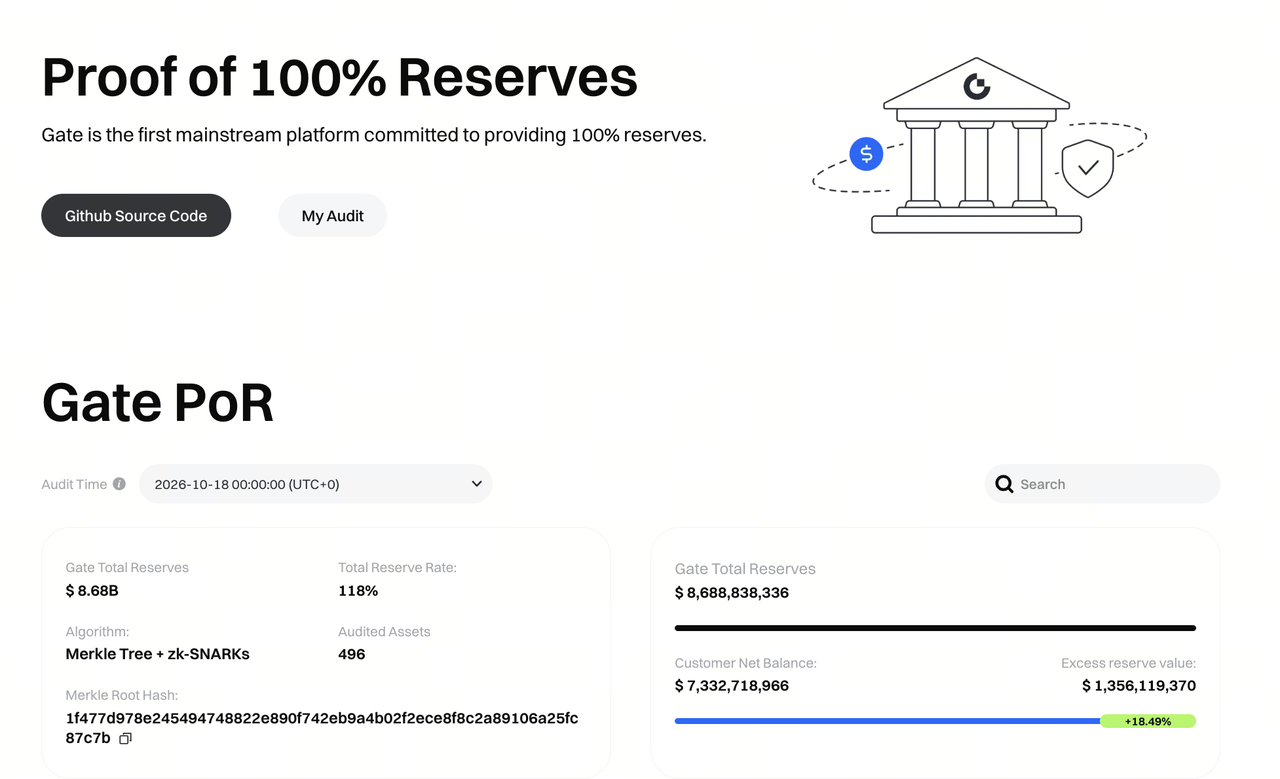
Gate provides a Proof of Reserves system designed to help users examine its published cryptocurrency reserve information and verify the inclusion of their account balances.
Gate began publishing third-party reserve assessments in 2020 and subsequently developed its reserve verification framework to incorporate cryptographic verification methods.
Its historical assessments included work conducted by Armanino LLP. These earlier reports should be distinguished from Gate’s current Proof of Reserves methodology and disclosures.
Gate’s official Proof of Reserves page provides information about supported assets, reported reserve coverage, and available verification methods.
What Is Gate’s Reserve Ratio?
Gate publishes reserve ratios for supported cryptocurrencies as part of its Proof of Reserves disclosures quarterly that is audited on a monthly basis. The reserve ratio compares the reported reserve assets against the corresponding customer liabilities included in the assessment.
For example, a reported BTC reserve ratio of 110% would indicate that the BTC reserves included in the calculation exceed the corresponding BTC customer liabilities by 10%.
However, this figure would apply only to the relevant assessment and snapshot date.
Because reserve balances and coverage ratios change, users should consult Gate’s latest published Proof of Reserves report rather than relying on historical figures.
How to Verify Your Assets Using Gate’s Proof of Reserves
Gate provides account-level verification functionality through its official Proof of Reserves page.
The exact verification interface and available methods may change as the system is updated.
The general process is as follows.
Step 1: Visit Gate’s Proof of Reserves Page
Open Gate’s official Proof of Reserves page and review the latest available reserve disclosures.
Check the assessment date, supported cryptocurrencies, and reported reserve ratios.
Step 2: Access Account Verification
Sign in to your Gate account through the official website.
Locate the account verification feature within the Proof of Reserves section.
Step 3: Obtain Your Verification Information
Follow the instructions provided by Gate to access the verification information associated with your account.
Depending on the verification method, this may include account-specific cryptographic data or a downloadable proof.
Step 4: Verify Your Account’s Inclusion
Use Gate’s supported verification method to check whether your account balance record was included in the relevant liability snapshot.
A successful verification establishes that the supplied record is consistent with the published cryptographic commitment.
Step 5: Review the Assessment Details
Confirm the snapshot date and supported assets.
If your account was created after the snapshot, or if the relevant balance was not included within the assessment’s scope, verification data may not be available for that period.
Remember that verifying your account’s inclusion in a Merkle tree does not independently prove that all customer liabilities were included or that the exchange is solvent.
Conclusion
Proof of Reserves provides cryptocurrency exchange users with a way to examine reported asset coverage and verify certain information about customer balances.
By combining blockchain data, cryptographic techniques such as Merkle trees, and reserve assessments, PoR can improve transparency around the assets held by centralized exchanges.
However, Proof of Reserves has limitations. It does not necessarily account for every financial liability, prove that reserve assets are unencumbered, or guarantee that withdrawals will always be available.
Gate’s Proof of Reserves system allows users to review published reserve information and use available verification tools to check their account’s inclusion in the relevant assessment.
When evaluating an exchange, users should consider Proof of Reserves alongside regulatory disclosures, custody practices, security controls, and other available financial information.
FAQ
What does a 100% reserve ratio mean?
A 100% reserve ratio means the reported reserve assets equal the corresponding customer liabilities included in the calculation. It does not necessarily establish overall exchange solvency or guarantee withdrawals.
What is the difference between Proof of Reserves and a financial audit?
Proof of Reserves focuses on specified asset holdings and, in some methodologies, customer liabilities. A financial statement audit evaluates financial statements under an applicable accounting and auditing framework and generally covers a broader range of financial information.
Can Proof of Reserves be manipulated?
PoR assessments can be misleading if relevant liabilities are excluded, assets are temporarily borrowed, or the methodology does not adequately verify asset control and encumbrances. The reliability of PoR depends on the completeness and quality of the assessment.
Does Proof of Reserves mean a crypto exchange is safe?
Proof of Reserves only provides additional transparency but does not eliminate custody, cybersecurity, liquidity, operational, or market risks.