


Web Tutorial Video
App Tutorial Video
Perpetual Futures Overview
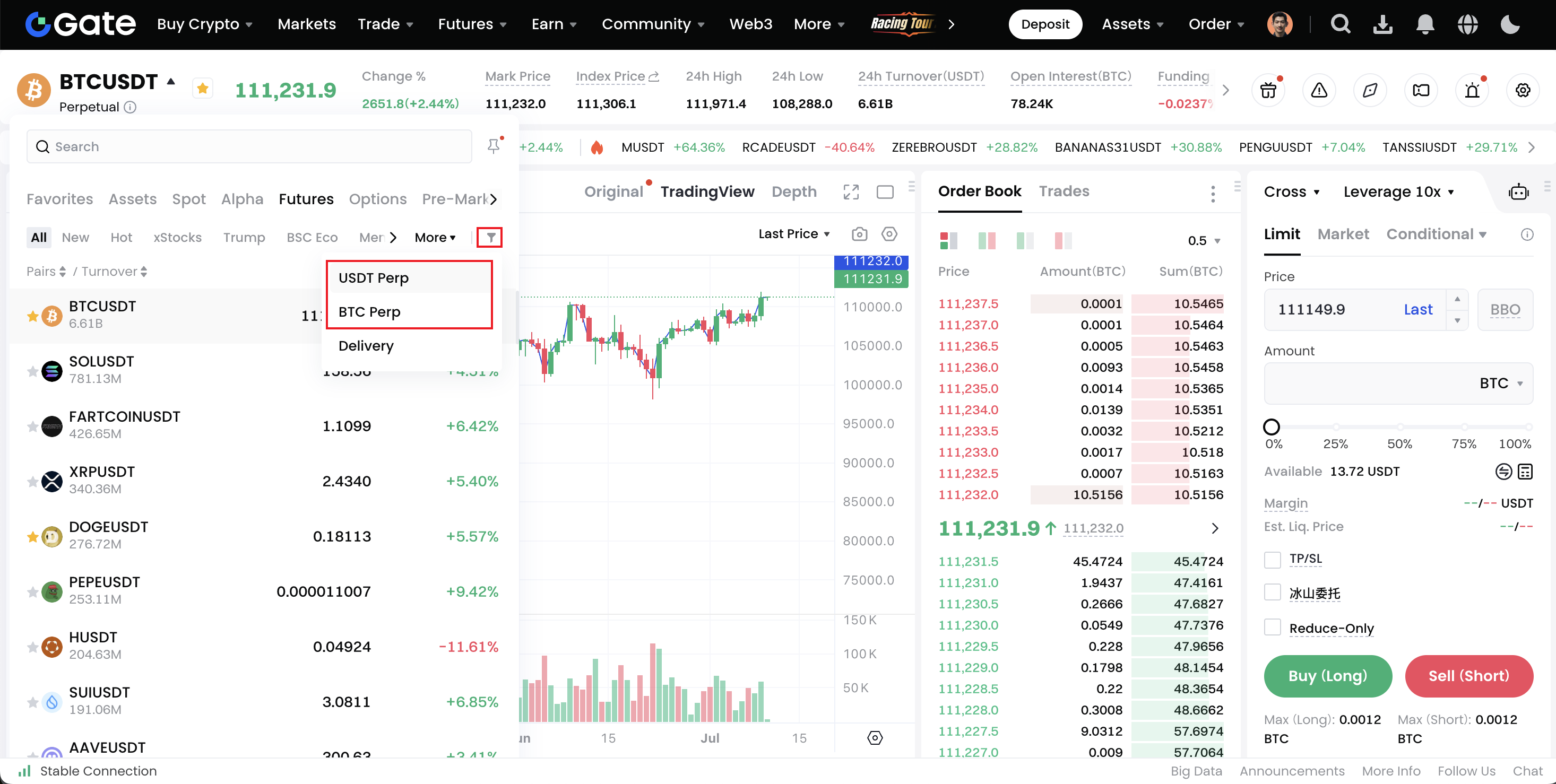
Gate perpetual futures are derivatives designed for cryptocurrency investment, similar to traditional futures. The key difference is that perpetual futures have no expiration or settlement date. Users can go long (buy) or short (sell), making trading more flexible while offering higher leverage than traditional futures. Gate currently supports USDT-M and BTC-M perpetual contracts.
Trading Mode
Gate offers two trading modes: live trading and demo trading.
Live trading is a real trading mode where users trade using the actual funds in their accounts. In this mode, users are required to pay trading fees and funding fees, and any profits or losses are directly reflected in their account balances. Since live trading involves real funds, it carries higher risks. Beginners are advised to start only after fully understanding and becoming familiar with the trading rules.
Demo trading allows users to experience perpetual futures trading with virtual funds. The interface and operations are identical to live trading and are clearly labeled as "Testnet." No real fees are incurred during demo trading. The platform provides virtual funds, allowing up to 0.1 BTC or 3,000 USDT to be transferred daily. These funds do not affect the users' actual assets, and the demo account balance cannot be transferred to the spot account.
Contract Types
Based on the duration, contracts are categorized into perpetual contracts and delivery contracts.
Based on the settlement currency, contracts can be divided into USDT-M perpetual contracts, which are settled in USDT, and BTC-M perpetual contracts, which are settled in BTC.
Basic Trading Terms
In trading, users can go long (buy) if they expect the market to rise, earning profits when prices increase and incurring losses when prices fall. Conversely, users can go short (sell) if they expect the market to decline. The following are some key concepts in futures trading.
Because futures allow users to trade with leverage, they can open larger positions with the same amount of principal. Leverage amplifies both potential profits and losses.
Margin
Margin refers to the principal required to open a position in futures trading.
Position Margin = Initial Margin + Manually Adjusted Margin
In isolated margin mode, users can add or reduce margin for a position, but it cannot be lower than the initial margin.
Initial margin is the minimum amount required to open a position.
Position Initial Margin = (Position Value / Leverage) + Exit Fee
Maintenance margin is the minimum amount required to keep a position from being liquidated.
Position Maintenance Margin = Position Value × Maintenance Margin Ratio (MMR) + Exit Fee
The maintenance margin depends on the position value and the MMR, which varies with the risk limit tier.
Applicable MMR can be viewed on the Contract Details page.
Mark Price
The mark price is derived from a weighted price of external market prices, adjusted by a time-decaying funding basis. Gate uses the mark price, rather than the last traded price, to trigger liquidations. This prevents malicious market manipulation from causing unnecessary liquidations and helps align on-platform prices with external spot market prices.
For details, see Mark Price Calculation.
Example
Alice buys 1 BTC spot directly at a price of 50,000 USDT without using leverage. If BTC rises 5% to 52,500 USDT, her profit is 2,500 USDT, a 5% return; if BTC falls 5% to 47,500 USDT, her unrealized PnL is -2,500 USDT, a -5% return.
By contrast, Bob trades a perpetual contract with 10x leverage. At a BTC price of 50,000 USDT, he buys 100,000 contracts (equivalent to 10 BTC) with an initial margin of 50,000 USDT.
If BTC rises 5%, his position value reaches 525,000 USDT, giving him an unrealized profit of 25,000 USDT, a 50% return.
If BTC falls 5%, his position value drops to 475,000 USDT, resulting in an unrealized loss of 25,000 USDT, a -50% return.
| Alice – Spot Trading | Item | Bob – Gate Perpetual Futures Trading |
|---|---|---|
| 50,000 | Entry Price (USDT) | 50,000 |
| No Leverage (1x) | Leverage | 10x |
| 50,000 (1 BTC) | Position Value (USDT) | 500,000 (10 BTC) |
| 50,000 (1 BTC) | Position Margin (USDT) | 50,000 (1 BTC) |
| 2,500 | Unrealized PnL if BTC +5% (USDT) | 25,000 |
| 5% | Return % | 50% |
| -2,500 | Unrealized PnL if BTC -5% (USDT) | -25,000 |
| -5% | Return % | -50% |
Note: This example does not include funding fees, trading fees, entry fees, or exit fees. For detailed liquidation information, see Liquidation Mechanism.
Liquidation
A position will be liquidated if the margin balance falls below the MMR (MMR ≤ 100%).
Unrealized PnL is calculated based on the mark price, which also determines the liquidation price.
The liquidation process relies sequentially on the market, the insurance fund, and the auto-deleveraging (ADL) system. For a given contract, the MMR is fixed, while the initial margin depends on leverage. Higher leverage reduces the initial margin, bringing it closer to the maintenance margin and making the position more susceptible to liquidation. At the same time, higher leverage also amplifies potential profits, meaning risk and return increase proportionally.
Example
Suppose Alice and Bob both expect BTC to rise. When BTC is priced at 50,000 USDT, Alice buys 1 BTC in spot trading, while Bob goes long in perpetual futures trading with 100x leverage, buying 1,000,000 contracts (equivalent to 100 BTC).
However, BTC unexpectedly falls to 49,900 USDT. Alice's loss rate is only 0.2%, whereas Bob's loss rate reaches 20%.
| Alice – Spot Trading | Item | Bob – Gate Perpetual Futures Trading |
|---|---|---|
| 50,000 | Entry Price (USDT) | 50,000 |
| No Leverage (1x) | Leverage | 10x |
| 50,000 (1 BTC) | Position Value | 100 BTC |
| 50,000 (1 BTC) | Position Margin (USDT) | 50,000 |
| -100 | Loss if BTC -0.2% (USDT) | -10,000 |
| -0.2% | Return % | -20% |
Later, if BTC continues to fall to 49,750 USDT, Alice's loss rate is 0.5%. Bob's position margin drops to only 0.5 BTC (0.5% maintenance margin), triggering liquidation and resulting in a total loss of his margin.
| Alice – Spot Trading | Item | Bob – Gate Perpetual Futures Trading |
|---|---|---|
| 50,000 | Entry Price (USDT) | 50,000 |
| No Leverage (1x) | Leverage | 10x |
| 50,000 (1 BTC) | Position Value | 100 BTC |
| 50,000 (1 BTC) | Position Margin (USDT) | 50,000 |
| -250 | Loss if BTC -0.5% (USDT) | -25,000 |
| -0.5% | Return % | -50% |
When a trader's position side aligns with market movements, futures can amplify the gains of a comparable spot position, allowing higher returns with relatively small principal. Conversely, if the position side goes against the market, losses are similarly magnified.
Note: This example does not include funding fees, trading fees, entry fees, or exit fees. For detailed liquidation information, see Liquidation Mechanism.
Insurance Fund
Liquidation is to close the position at the bankruptcy price, and the bankruptcy price is the mark price at which the margin balance (including unrealized PnL) is equal to the exit fee. If the actual fill price is better than the bankruptcy price, the remaining amount (i.e., the lesser loss) will be credited to the insurance fund, which will be activated if the liquidation order is not executed by the time the mark price breaks the bankruptcy price.
For details, see the Insurance Fund.
Auto-Deleveraging (ADL)
If the insurance fund is insufficient to cover liquidation losses, the ADL system will be triggered. ADL reduces the positions of users with the highest profit ranking to fulfill the remaining liquidation orders. Profit ranking is calculated based on Unrealized PnL × Leverage. For cross-margin positions without a preset leverage limit, the position's effective maximum leverage is used. Users selected for ADL will have all pending orders canceled first, and their positions will then be reduced accordingly. The indicator lights on the Gate website show users' current position in the ADL queue. The more lights are lit, the higher the likelihood that the position will be reduced during an ADL event. To reduce ADL risk, users with high ADL rankings are advised to close or reduce their positions proactively.
Position Mode
Cross Margin Mode and Isolated Margin Mode
In isolated margin mode, the position margin is a fixed amount. It is equal to the initial margin at the beginning and may be affected by leverage, risk limit, or margin deposits or withdrawals. When the margin balance is less than the maintenance margin, the position is liquidated and the loss is limited to the allocated margin.
In cross margin mode, all balances in the user's futures account are used as margin, and all positions share this margin. Users can set multiple contract positions as cross margin mode. Liquidation is triggered when the MMR falls to 100% or below, which may result in the loss of the entire account balance. However, unrealized profits from profitable positions cannot be used as margin for other positions.
One-Way Mode, Hedge Mode, and Hedge Split Mode
In Gate futures trading, position modes include one-way mode, hedge mode, and Hedge Split mode. Each mode offers distinct features and is designed to support different trading strategies and risk preferences.
1. One-Way Mode
- In one-way mode, users can only hold positions on one side in a market, either long (buy) or short (sell). This means that to switch sides, the existing position must be closed before opening a new one.
- Gate uses hedge mode by default.
- One-way mode offers flexibility, allowing users to switch between isolated and cross margin while holding a position.
2. Hedge Mode
- In hedge mode, users can hold both long and short positions simultaneously in the same market. This mode is ideal for users who want to hedge against market uncertainty by holding positions on both sides.
- However, in hedge mode, switching between isolated and cross margin while holding positions is not allowed, which increases operational complexity but enables more diverse strategies.
3. Hedge Split Mode
In Hedge Split mode, users can hold both long and short positions in the same market while using cross margin and isolated margin simultaneously, enabling multiple trading strategies to run in parallel. Hedge Split mode offers the following features:
- Supports up to four positions per market: cross-margin long, cross-margin short, isolated-margin long, and isolated-margin short.
- Allows cross-margin and isolated-margin positions to coexist within the same market.
- In isolated margin mode, long and short positions can be set with different leverage levels. Leverage settings for cross-margin and isolated-margin positions are managed independently.
- Each isolated-margin position is risk-isolated. The profit, loss, or liquidation of one isolated position will not affect other positions in the same market.
By selecting the position mode that best suits their needs, users can better manage risk and return, enabling more flexible operations in a volatile market environment.
Order Price Limit
The order price cannot deviate from the current mark price by more than 50%. If the order is intended to reduce a position, the order price cannot exceed the position's bankruptcy price. If the order is to increase a position, the order price cannot exceed the position's liquidation price. If the user still wishes to execute the order at the specified price, it is recommended to reduce the leverage and then attempt to place the order at the desired price again.
Gate reserves the final right to interpret the product.
For further assistance, please visit the Gate official support page or contact our customer support team.
Disclaimer
The content provided herein is for reference and educational purposes only and does not constitute any financial, investment, trading, or legal advice, nor does it constitute an offer or solicitation to buy or sell any digital assets. Gate makes no express or implied representations or warranties regarding the accuracy, completeness, or timeliness of the information contained herein. Product features, interfaces, rules, and fee structures may be updated or adjusted at any time. Please refer to the latest announcements and the actual information displayed on the Gate platform for the most accurate details.
Digital asset investments involve significant risk, and prices may fluctuate substantially. You may lose the entire amount of your investment. Please make decisions cautiously based on your own financial situation and risk tolerance after fully understanding the associated risks. If necessary, you are advised to consult an independent professional financial or legal advisor.
For more information about potential risks, please refer to Gate's Risk Disclosure and User Agreement.
